
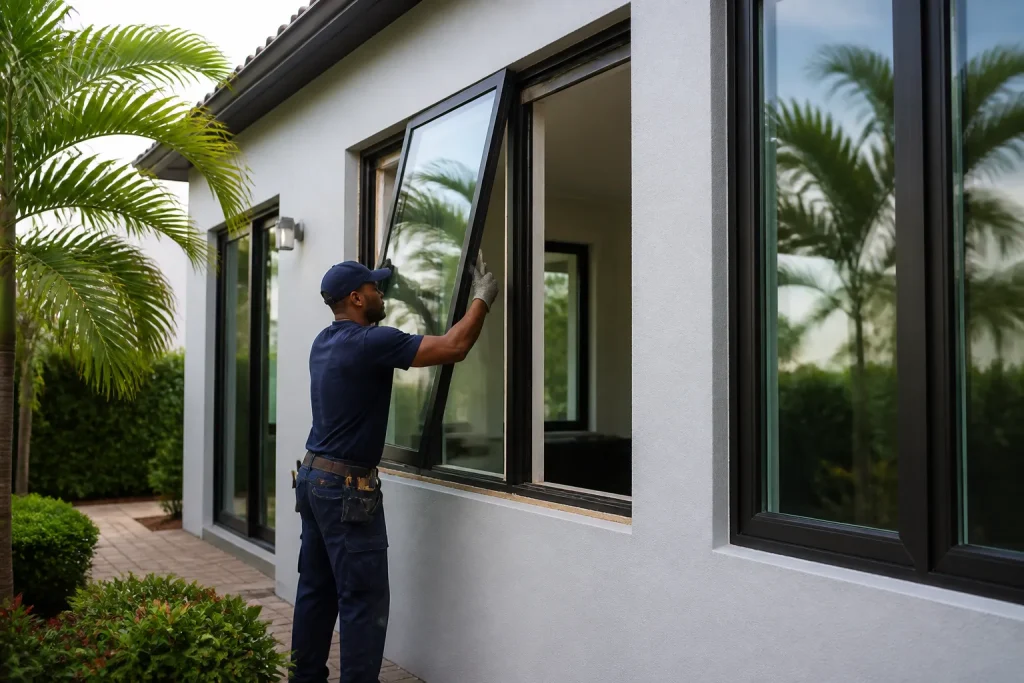
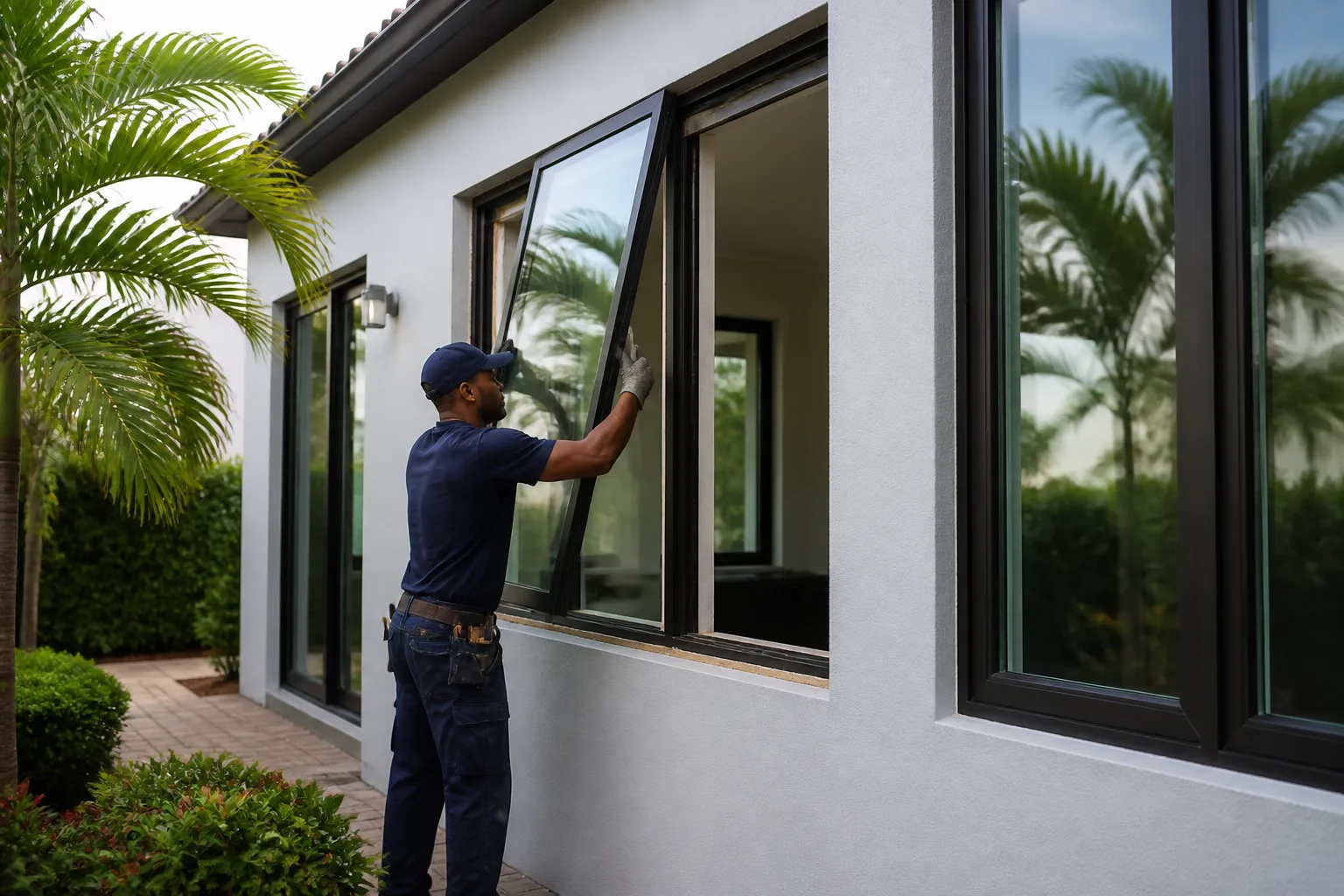
Emergency Window Installation Near Me: What Miami Gardens Homeowners Should Do First
If a window just blew out or cracked during a storm in Miami Gardens, the first thing to do is not call an installer. The first thing is to photograph the damage from multiple angles, note the time, and write down what you saw happen before anyone touches the opening. Then call your insurance carrier. Only after the adjuster has been notified and you have a claim number should you board up or tarp, get a permit started, and line up a licensed contractor. If you’d rather not navigate any of that alone, call TruePane Windows & Doors at (386) 516-5343 and we’ll walk you through it.
Florida insurance adjusters are trained to look for evidence that a homeowner or a contractor altered the damage site before documentation was complete. A well-intentioned emergency board-up, done without photographing the failure point first, has been cited in claim reduction decisions in Miami-Dade County. The first hour after a window fails matters more than most people realize, and the order of operations is where claims get won or quietly reduced.
Step One: Document the Failure Before You Touch Anything
We have watched homeowners lose thousands of dollars over this. The instinct after a window blows in is to start cleaning up the glass and staple a tarp over the opening. Do not do that yet. Your phone camera is the most valuable tool on the property in that first hour.
Take timestamped photos of the window from the inside and the outside. Get close enough to show the failure point: where the glass cracked, whether the frame pulled away from the wall, whether the latch held or gave way. Photograph the glass fragments where they landed, not after they have been swept into a pile. If water came in, photograph the wet drywall, the floor, and anything the water touched before you dry it.
Then write down, in plain language, what you observed: when the window failed, what the weather was doing at that moment, whether the glass shattered inward or outward, and what you heard. Adjusters read these descriptions and compare them against the physical evidence. A homeowner who can say “the glass bowed inward before it broke” gives the adjuster something concrete to match against the stress fractures. A homeowner who says only “it broke” leaves the cause open to interpretation, and interpretation rarely favors the policyholder.
Step Two: Notify Your Carrier, Then Secure the Opening
Once the documentation exists, call your insurance company. Give them the facts you recorded and get a claim number written down. Ask directly what your policy covers for emergency mitigation under Florida law. Most standard Florida homeowners policies include reasonable coverage for temporary measures like tarping and boarding to prevent further damage. That is mitigation, not permanent repair, and the distinction matters for how the claim is categorized.
Here is where Miami Gardens homeowners get caught: if you hire a contractor to do the temporary board-up and that same contractor later quotes the permanent replacement, the adjuster may look at the two scopes as one continuous job. That is usually fine if the contractor is licensed and documents everything properly. But if the contractor does shoddy mitigation work, leaves exposed fasteners, or overcharges for plywood at post-storm rates, it can become a line item the carrier disputes. Choose the mitigation contractor the same way you would choose a permanent one: licensed, insured, and willing to put the scope in writing.
We have pulled plenty of storm-damaged windows out of homes in the Bunche Park and Brentwood neighborhoods where the board-up was done in a hurry by whoever knocked on the door first. The nails into stucco, the wrong plywood thickness, the tarp stapled into the window frame instead of the wall. Every one of those shortcuts creates a conversation with an adjuster that did not need to happen.
Securing the opening correctly means attaching the board or tarp to the wall structure, not the window frame, and photographing that work when it is done. If you can do the board-up yourself safely, fine. If you cannot, hire a licensed contractor and keep the receipt. Your policy likely reimburses for it, and even if it does not, it is a few hundred dollars against thousands in water and intrusion damage.
Step Three: Vet Any Contractor Who Shows Up Uninvited
After a storm in Miami Gardens, unlicensed and out-of-state crews circulate through the neighborhoods. They knock on doors with a truck, a business card, and a pitch that sounds urgent. Some of them are legitimate. Some of them are not, and the difference is checkable in under five minutes.
Every contractor doing window installation in Florida must hold a state license through the Florida Department of Business and Professional Regulation, or DBPR. Go to the DBPR website, enter the contractor’s name or license number, and confirm the license is active and matches the person standing in your driveway. Then run the same name through the Miami-Dade County contractor search. Miami-Dade has its own licensing layer for building trades, and a contractor who is cleared at the state level but not the county level is not legally permitted to pull permits here.
Ask for proof of general liability insurance. Ask whether they carry workers’ compensation. A contractor who cannot produce both is asking you to carry the risk if someone gets hurt on your property. That risk in Florida is not theoretical. If an uninsured worker falls off a ladder at your house, the claim can land on your homeowners policy, and your premiums will remember it for years.
We tell homeowners to trust the pattern, not the pitch. A contractor who has been serving Miami Gardens for decades has a paper trail: permits pulled, inspections passed, city records you can look up. A contractor who appeared for the first time right after a storm has no local trail, and that alone is a piece of information worth weighing.
Step Four: Understand That the Permit Is Not Optional, Storm or No Storm
Miami-Dade County requires a building permit for window replacement, including emergency replacement. There is no secret post-storm exemption that lets a contractor skip the permit, but there are expedited pathways the county opens after major weather events. A licensed contractor can navigate those pathways and get the permit pulled faster than during normal permitting cycles.
If a contractor tells you the permit is unnecessary for an emergency window replacement in Miami Gardens, that is a clear signal about how they run their business. Unpermitted window work creates problems that surface later: the window may not meet Miami-Dade’s high-velocity hurricane zone, or HVHZ, product approval requirements. The homeowner is then the one holding a non-compliant window when the next inspection happens or when the property is sold. Buyers and their inspectors check permit records, and missing permits show up.
The permitting process also creates a record that can help an insurance claim. A permit with the scope of work, the product approval numbers, and the inspection sign-off is documentation the adjuster can verify. It says the work was done to code by a licensed contractor. That is a stronger position than a cash job with no paper.
We pull permits on every window installation we do in Miami Gardens, emergency or scheduled. The inspection is not a formality to us. It is the document that says the window was set square, sealed, and compliant with the wind load requirements for our zone.
Step Five: Get the Scope, Lead Times, and Warranty in Writing
Emergency window replacement in Miami Gardens is not the same as a planned replacement. Material lead times shift after a storm because manufacturers allocate stock to affected regions. A window that normally ships in two weeks could take six when every supplier along the Gulf Coast and the Atlantic side of Florida is pulling from the same inventory. That is a fact of the storm cycle, not a contractor’s failure.
What should be in writing before any work begins:
- The exact window or door product line being quoted, with the manufacturer name and the model designation.
- The lead time from order to installation, in writing, with an acknowledgment that lead times can shift and how the contractor communicates those shifts.
- The temporary closure method that will stay in place until the permanent window arrives: interior board-up, exterior board-up, or a temporary glazing panel.
- The warranty terms: manufacturer warranty duration, the workmanship warranty duration, and who registers which layer with which party.
- The permit number once it is pulled, and the inspection date once it is scheduled.
A 90-day workmanship guarantee in an emergency context means something specific. It means that if the window is not set right, if the seal fails, if the frame shifts because the opening was not properly prepped, the contractor comes back and fixes it without arguing. In a planned installation, the finishing details are easier to schedule. In an emergency replacement, the temporary closure, the final installation, and the inspection may be weeks apart. A written scope keeps all of that straight.
That is the Keystone Standard at TruePane: both manufacturer warranty layers registered in writing before our truck leaves the driveway, durations stated on paper, and the 90-Day Done Right Promise covering workmanship. No paperwork fights. No fine print that covers neither.
Step Six: Choose a Contractor Who Will Be Here in Ten Years
Dale Kessler founded TruePane in 2008 out of a simple frustration: he kept seeing out-of-true window installs and voided warranties that could have been avoided if someone had slowed down and done the job right. Over 42 years of glazing work taught him what “done right” looks like, and the company has carried that standard through every installation since.
We are an authorized installer for more than a dozen manufacturer lines, including Andersen, PGT, and ES Windows. That means we quote side by side on paper so you see exactly what each line costs and what each warranty covers. You do not get a salesman’s favorite brand. You get the brands that fit your house, your budget, and your storm exposure, laid out in plain language.
When you call TruePane, a live person answers the phone. Not a voicemail tree, not a regional call center. Someone who knows Miami Gardens and knows windows picks up, 24 hours a day, seven days a week. Our technicians are background-checked and uniformed, and they measure every opening twice. They quote manufacturer lines side by side. They register both warranty layers before the truck leaves the driveway. If the pane is not true, the job is not done.
We pulled one out of a garage over in the Andover Lakes area last year where the homeowner had gone with a door-to-door crew after Hurricane season. The window was set so far out of plane that the sash would not close against the weatherstripping in the afternoon heat. The manufacturer voided the warranty because the install did not meet their published installation tolerances. The homeowner paid for that window twice: once to the crew that put it in wrong, and once to us to take it out and do it right. That is a hard lesson, and it is the reason we write our standards down on paper.
When to Call a Pro
If the window failure is a hairline crack with no water intrusion, you have time to get estimates. If the glass is shattered, the frame is compromised, water is coming in, or the opening cannot be secured safely, call a licensed contractor immediately. Emergency window work involves sharp glass, compromised framing, and sometimes structural movement in the opening. That is not a weekend project, and it is not a task to hand to someone who is not trained in high-velocity hurricane zone installation standards.
If you are in Miami Gardens and need help right now, call TruePane at (386) 516-5343. We will document the damage, guide you through the insurance sequence, and get your opening secured and scheduled for permanent replacement. Estimates are free.
Related services in Miami Gardens: Window Installation in Miami Gardens · Window Replacement in Miami Gardens · Door Installation in Miami Gardens · TruePane Windows & Doors home
The Bottom Line
- Document everything before anyone touches the window. Timestamped photos and a written account protect the claim.
- Notify the insurance carrier before securing the opening. Get a claim number.
- Temporary mitigation is not the same as permanent repair. Keep the scopes separate in writing.
- Vet every contractor through the Florida DBPR and Miami-Dade county search. It takes under five minutes.
- Permits are required for window replacement in Miami-Dade, including emergencies. No exceptions.
- Get lead times, warranty terms, and scope in writing before work begins.
If you are in Miami Gardens and need help, TruePane Windows & Doors offers free estimates. Call (386) 516-5343 and a live person will pick up the phone. We have been standing behind our work in this community for over 42 years, and we plan to be here in thirty more.
Frequently Asked Questions
Emergency window installation in Miami Gardens typically runs from $400 to $900 per standard window for the temporary board-up and securing work, then $800 to $2,500 or more per window for the permanent replacement, depending on the product line, size, and whether it is impact-rated. Call (386) 516-5343 for an exact quote on your specific opening. Estimates are free.
Most standard Florida homeowners policies cover temporary mitigation like tarping and boarding as part of the claim, and permanent replacement is covered minus your deductible when the damage is from a covered peril like a hurricane or windstorm. Coverage depends on your policy language, your deductible, and whether the cause of failure is a covered peril. Document the damage before calling, and call (386) 516-5343 if you need help walking through the sequence.
Yes, you can board up your own window as a temporary measure, and many homeowners do it safely with the right materials. Photograph the damage first, then secure the plywood to the wall structure, not the window frame. If the opening is large, high off the ground, or the frame is compromised, have a licensed contractor handle it. The cost of a professional board-up is often reimbursable under your policy.
Miami-Dade County sits in a high-velocity hurricane zone, and every window installed here must meet wind load and product approval standards that county inspectors verify. A permit creates the inspection record that proves the window was installed to code. That record protects you when you sell the house and supports the insurance claim. A contractor who says no permit is needed after a storm is not doing you a favor.
Written by Dale Kessler, Owner at TruePane Windows & Doors, serving Miami Gardens since 2008.
Need Windows & Doors Help?
Call TruePane Windows & Doors - licensed & insured, here with fast after-hours help in Miami Gardens.
(386) 516-5343